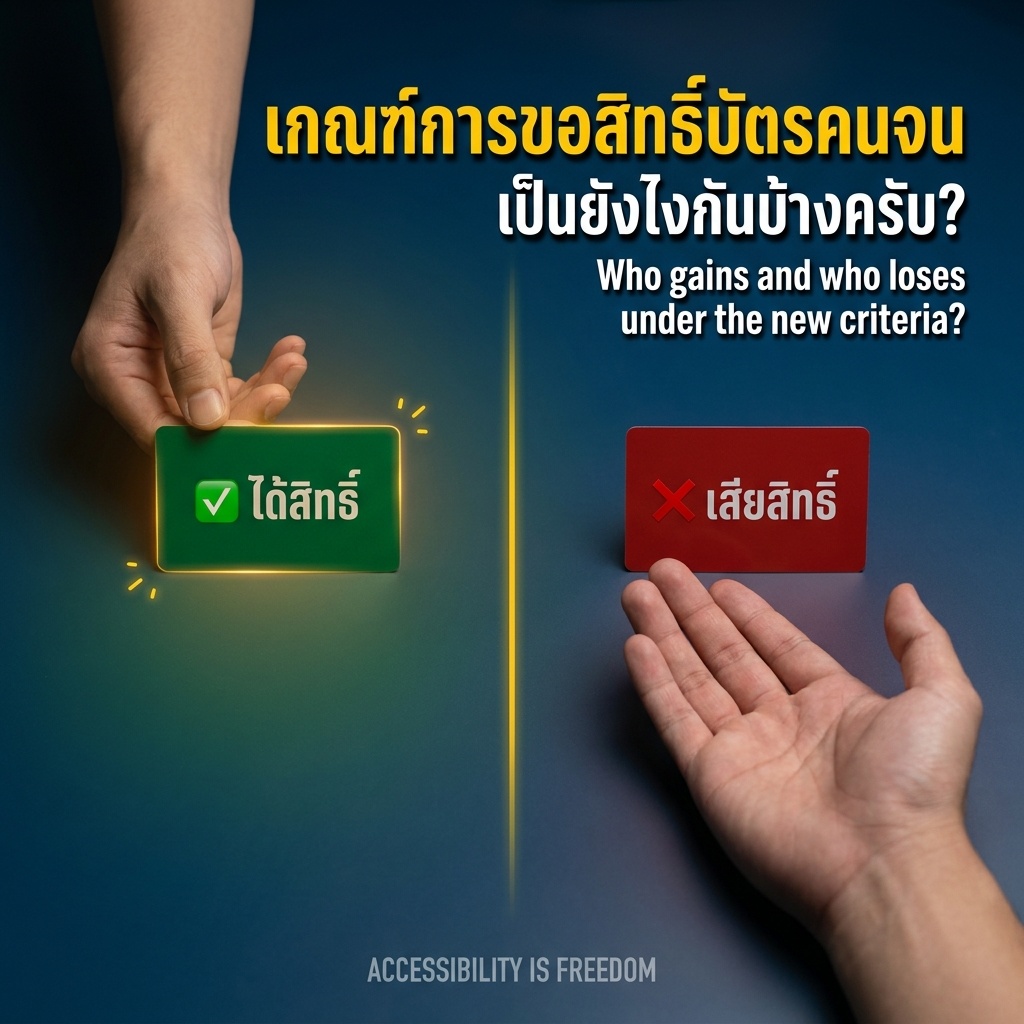
On July 17, 2026, Thailand’s Ministry of Finance announced the results of the latest round of State Welfare Card (บัตรสวัสดิการแห่งรัฐ) screening. This marks a pivotal moment in the program’s history: for the first time, eligibility is determined on an individual basis rather than by household. Under the slogan “Easy Access, Equality, Ready for the Future,” the shift is designed to paint a clearer picture of who is truly poor — but it also means some people gain eligibility while others who previously qualified now fall through the cracks.
💰 Income Criteria: The Core of the Screening
The Ministry of Finance applies three interconnected income-related criteria in this round:
First — Individual income must not exceed 100,000 THB per year, or approximately 8,333 THB per month. This figure measures each person’s earning capacity independently, no longer pooling the income of all household members together.
Second — Total financial assets are capped at 100,000 THB. This includes all bank deposits, government savings lottery holdings, treasury bonds, and other financial instruments held in the applicant’s name.
Third — Outstanding credit or debt balances must not exceed 100,000 THB, with an exception for agricultural loans. The system is reported to be linked to the National Credit Bureau (NCB), making screening significantly stricter — individuals with even small amounts of debt on their credit history may be disqualified, regardless of the circumstances that led to that debt. Additionally, applicants must not hold any credit cards at all.
🏠 Asset and Vehicle Criteria
Beyond income, asset thresholds define the maximum allowable property holdings: residential land capped at 1 rai (1,600 square meters), agricultural land at no more than 10 rai, detached houses, townhouses, or shophouses limited to 25 square wah (approximately 100 square meters), and condominium units no larger than 35 square meters.
For vehicles, the rule is “prohibited with exceptions”: one motorcycle up to 300cc, one private car, one public transport vehicle, and one agricultural vehicle — strictly limited to one vehicle per category. Owning two vehicles of the same type results in immediate disqualification.
🚫 The 8 Groups Excluded from Registration
The Ministry of Finance lists eight categories of individuals who are barred from registering for the welfare card:
1. Buddhist monks, novices, ascetics, and clergy — as they already receive community support.
2. Prisoners and detainees in correctional facilities — under state care.
3. Residents of state welfare institutions — already within the state welfare system.
4. Students at all levels — still under the financial dependency of guardians.
5. Government officials, state employees, and public sector workers — except pensioners earning no more than 100,000 THB per year, who may register.
6. Political office holders — including ministers and local government executives.
7. Members of Parliament (MPs) and Senators.
8. Individuals declared bankrupt, shareholders in partnerships or companies, holders of securities or debt instruments, holders of life insurance policies with annual premiums of 12,000 THB or more, and children claimed as tax deductions by parents.
🎁 Benefits: What Cardholders Receive
Those who pass screening and complete identity verification gain access to a package of monthly benefits, effective August 1, 2026, for existing cardholders and October 1, 2026, for new recipients:
– 300 THB per month for consumer goods, accessed via the welfare card or the Pao Tang mobile application.
– 750 THB per month for public transportation, covering buses, rail transit, and inter-provincial bus services.
– 315 THB per month in electricity bill subsidies.
– 100 THB per month in water bill subsidies.
– 80 THB discount on cooking gas every three months.
Combined, these benefits are worth over 1,300 THB per person per month — a meaningful contribution toward easing the cost of living for low-income Thais.
⚠️ Analysis: Who Wins and Who Loses Under the New System
One — The individual-based approach is a double-edged sword. The upside: genuinely poor individuals who were previously excluded because a family member in the same household had higher income can now qualify on their own merits. The downside: household members who passed under the old system may now fail because assets registered in their own name exceed the new thresholds — even if their actual per-capita standard of living remains extremely low.
Two — The tighter debt criteria linked to the NCB have real consequences. People with minor historical debt from cash cards or small personal loans are being disqualified, even when that debt was taken on out of survival necessity rather than discretionary spending. The Ministry of Finance has published a guide titled “Procedures for Applicants Who Failed the Debt Criteria” for those wishing to appeal, but navigating this process remains complex and inaccessible to many.
Three — The registration window lasted only 18 days (June 4–21, 2026), drawing heavy criticism as insufficient — particularly for elderly people and persons with disabilities in remote areas. Identity verification (e-KYC) requires a smartphone via the Pao Tang app, creating a significant barrier for those without devices or digital literacy.
Four — Those who were screened out have only 14 days to appeal (July 17–31, 2026). The short window and the concentration of information in online channels mean that people with limited access to news and official communications lose their chance by default. While the Ministry of Interior operates hotline 1548 for those who fell through the registration cracks and the Ministry of Finance maintains a customer relations center at 02-109-2345, reaching these services remains a challenge for those on society’s margins.
♿ Accessibility for People with Disabilities and the Elderly
For elderly individuals, people with disabilities, and bedridden patients unable to travel for registration or identity verification, the program allows proxy registration through a power of attorney. Required documents include: the program’s power of attorney form, copies of the national ID cards of both the applicant and the proxy (each certified as true copies), and a copy of the disability ID card or medical certificate where applicable.
In practice, however, gaps remain — many people with disabilities who lack close relatives or caregivers still cannot access the process. The existence of a proxy system on paper does not guarantee real-world accessibility.
📅 Key Dates to Know
– June 4–21, 2026: Registration period (now closed).
– July 17, 2026: Screening results announced.
– July 17–31, 2026: Appeal window for unsuccessful applicants.
– August 1, 2026: Existing cardholders begin using benefits.
– September 21, 2026: Appeal results announced.
– October 1, 2026: New cardholders and successful appellants begin using benefits.
– January 12, 2027: Final deadline for identity verification.
The most urgent actions right now: if you registered — check your status at welfare.mof.go.th. If you passed — complete identity verification before the January 12, 2027 deadline. If you did not pass — file your appeal by July 31, 2026.
The shift from household-based to individual-based criteria is a step in the right direction for directing welfare assistance to those who need it most. But the line between qualifying and being left behind remains riddled with gaps worth watching — from punishingly tight deadlines, to online systems that exclude the elderly and disabled, to debt criteria that draw no distinction between necessity and excess.
Did you or someone you know pass or fail under the new criteria? What do you think of the updated system? Share your experience in the comments below 👇
Sources: Ministry of Finance, welfare.mof.go.th, Department of Provincial Administration
## Internal Notes (NOT for Facebook)
Limitations: Based on Ministry of Finance announcements as of July 17, 2026 — criteria details may be adjusted during the appeal period.