

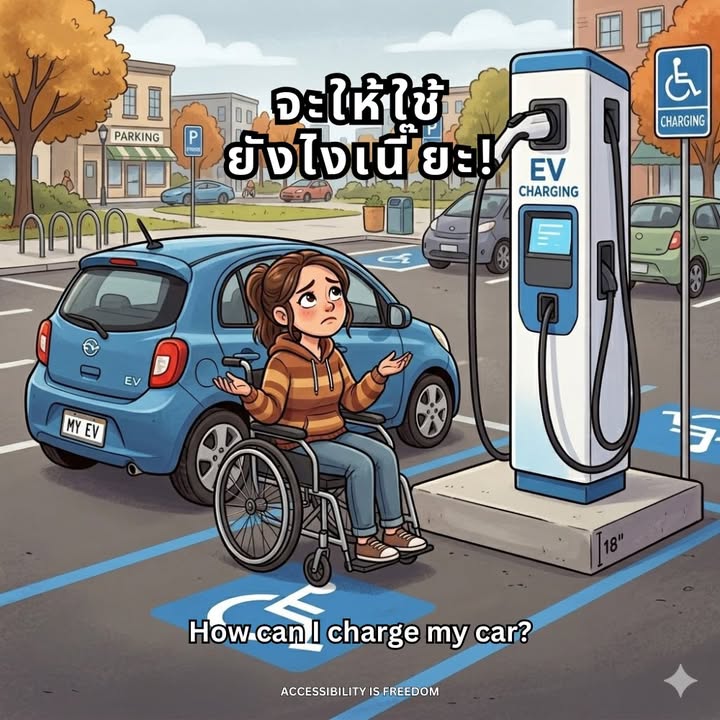
The European Union just issued a new rule prohibiting electric vehicles from parking in and charging at spaces designated for people with disabilities.
This follows a finding that 75% of people with disabilities reported EV charging points are extremely difficult to access — whether because charging stations are mounted too high, sidewalks lack ramps, or charging cables are too heavy to handle.
Just imagine… you need to wheel yourself to charge an EV, but the charging cable weighs 10 kg, or the station is mounted too high to reach.
EU Directives 2024/2841 and 2024/2842, approved in October 2024 and coming into full force in 2028, will create a “European Parking Card” system that prevents disabled parking spaces from being occupied by regular electric vehicles.
This confirms the right to parking for people with disabilities across all 27 EU member states.
And what about Thailand?
Thailand has 2.2 million people with disabilities — that’s 3.33% of our population.
Yet the BEV 3.5 policy announced in 2024 doesn’t consider accessibility for people with disabilities at all.
There are no requirements for EV charging stations to be accessible.
There is no protection preventing disabled parking spaces from being converted into EV charging spots.
The reality is that existing charging stations cannot be used by people with disabilities.
And at many shopping malls, disabled parking spaces have already been converted into EV charging stations.
Every time I see this, I can only sit there and look on in disbelief.
Source: EU Directives 2024/2841, 2024/2842