
Part 2: The Legal System Keeping Watch
Yesterday we talked about how Japanese people are willing to clean. But what if there were no laws backing them up? Good intentions alone surely wouldn’t be enough.
Japan has more than 10 waste control laws, starting from 1993. There are 3 important ones — the Basic Environment Law (1993) is the foundation, the Container and Packaging Law (1995) requires separating bottles and boxes by type, and the 3R Law (2000) mandates the order: reduce first, reuse, then recycle. Every law has clear penalties.
But laws alone aren’t enough — there need to be incentives too.
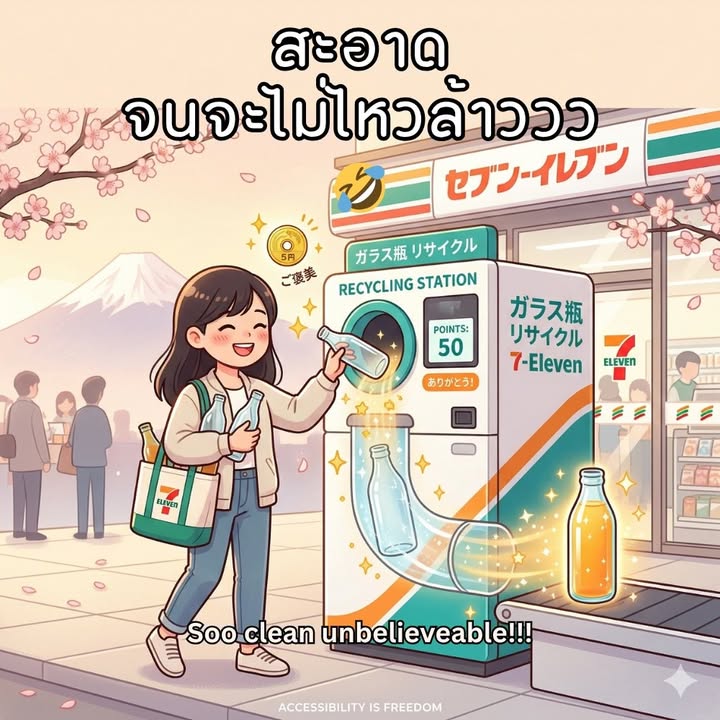
What’s cool is the circular economy system! Japanese beer bottles are worth 5 yen. When you return them, you get your money back — 99% are returned. After return, they’re washed and reused for 8-10 years, circulating more than 3 times per year. There are recycling machines at 7-Eleven where you can return bottles and earn points.
The word “Mottainai” (もったいない) — this concept of “what a waste” has become national policy. It’s not just about reducing trash, but about seeing value in resources.
The result? Japan recycles up to 84% of waste, while Thailand is at 32% — almost 3 times different! It’s not because Japanese people are “better,” but because their system is complete.
The legal framework and culture are already there. But how can Thailand adopt this? I want to see our country have a bottle return system like this. Just having bottle return machines at 7-Eleven would change people’s behavior.
Part 1: Society and Culture
Part 2: The Legal System Keeping Watch
Part 3 Finale: Even with Challenges, I’m Happy — Thailand Has Started! Let’s Push Together a Little More…
Source: fukuoka-city, aisco