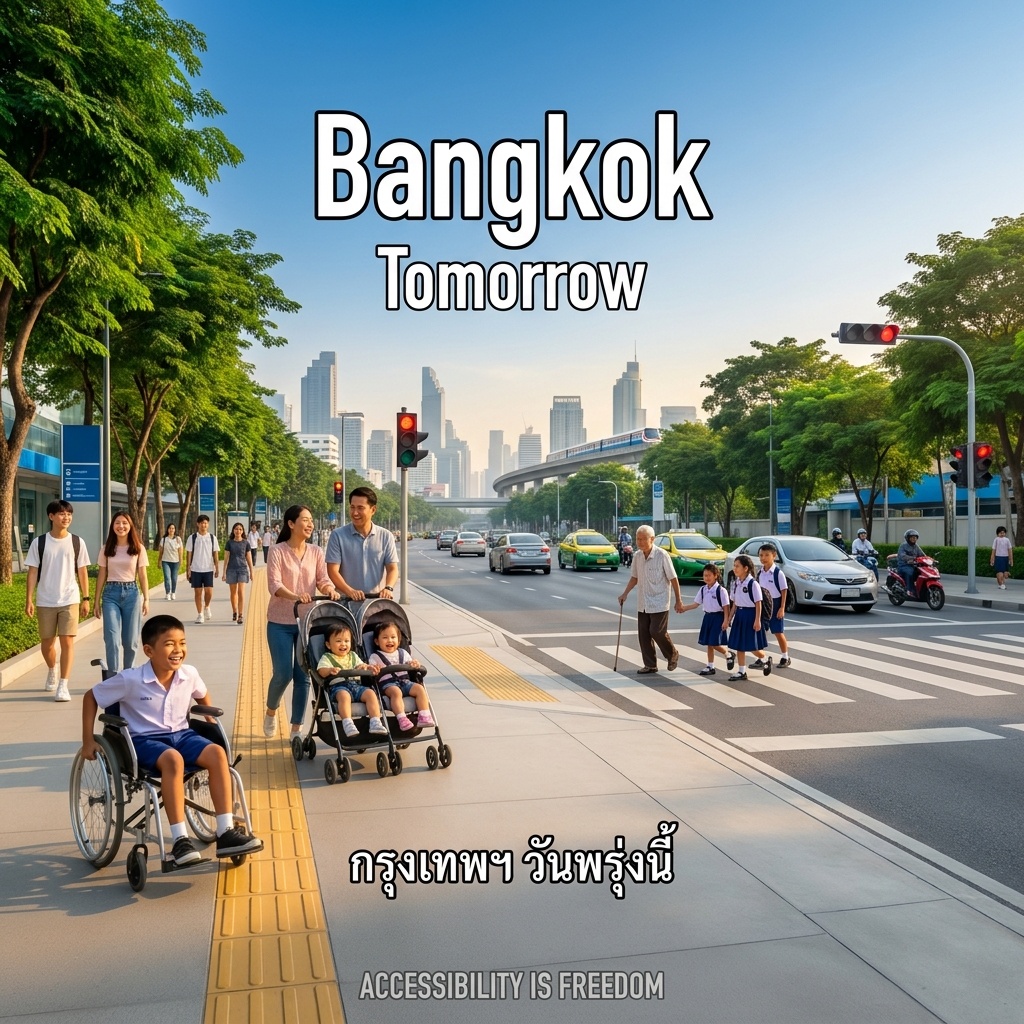
Wouldn’t it be amazing if Bangkok, in the future, became a city where everyone can travel easily and safely? Whether you’re a wheelchair user, a parent pushing a stroller, or a tourist dragging a suitcase, imagine sidewalks that meet international standards—with smooth, continuous surfaces, no electric poles or advertising signs blocking the way, no motorcycles riding on the sidewalk, no vendor carts encroaching, and no buildings squeezing the road edge. I’m confident Bangkok can do this.
Japan has proven this isn’t just a dream. Tokyo has had Barrier-Free Law since 2006, and it got stricter in 2020. This law requires train stations to have elevators and ramps, and tactile paving is widely used on sidewalks. Japan’s road death rate is 2.1 per 100,000 people, while Thailand’s is 25.4 per 100,000—over 12 times higher. This difference isn’t about culture; it’s about serious enforcement. Japan has on-the-spot fines for cycling while using a phone—¥12,000 (about 3,000 baht). Wrong-way driving carries heavy penalties, and there’s a point system affecting all driver’s licenses.
If Bangkok adopts this approach, sidewalks must meet three basic criteria: sufficient width, proper slope and surface, and route continuity. No more overpasses that many people struggle to use and others can’t use at all—every necessary overpass needs an elevator.
The sidewalk environment must be clean, safe, and convenient. Adequate lighting, no blind spots, no littering. Government agencies must work intensively, continuously, seriously, and honestly.
Bangkok tomorrow isn’t just a beautiful city—it should be a city where everyone can live together happily. Whether you walk on two feet, use a wheelchair, or have other limitations, design for all is the heart of a progressive city.
Sources: Accessibility Is Freedom