
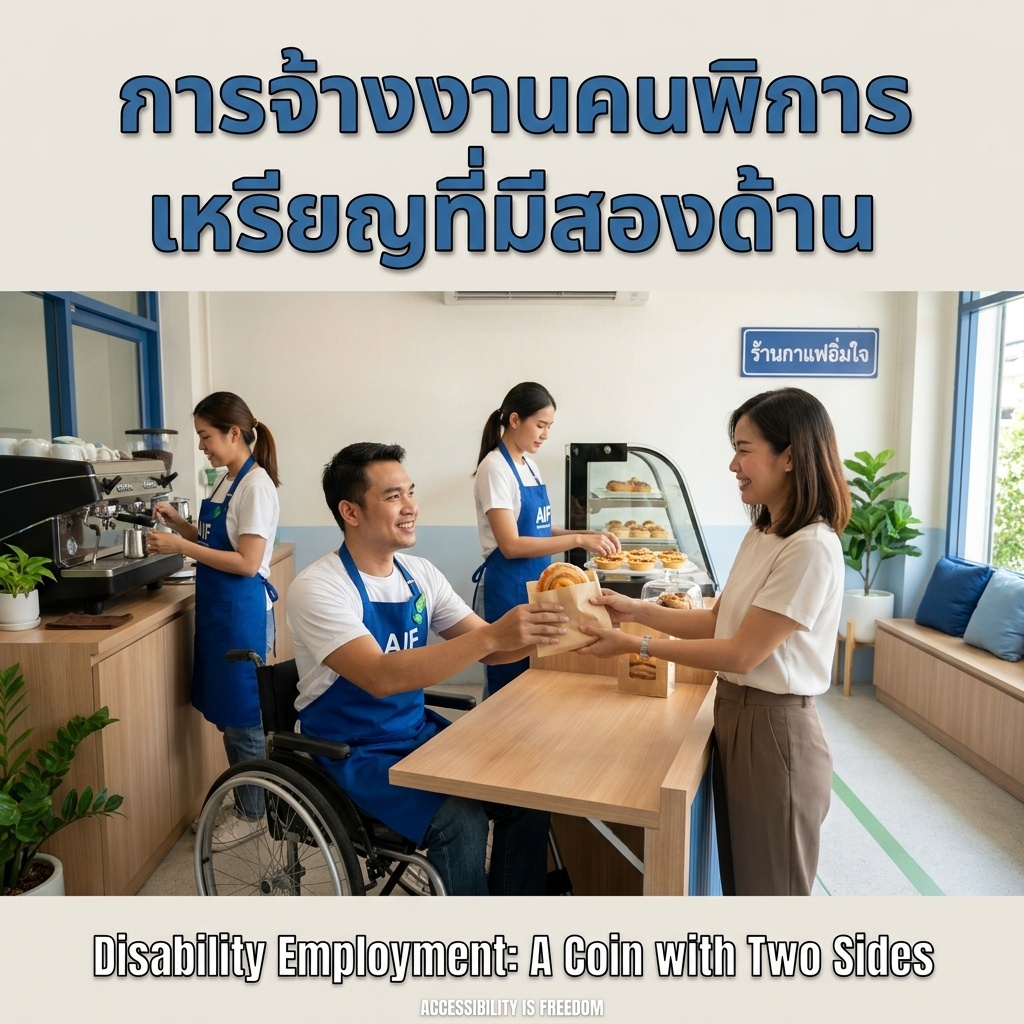
People with disabilities keep telling me: disability employment Thailand has had a law for nearly 19 years, yet good jobs stay out of reach.
Some 2.31 million hold disability ID cards (July 2026 data); a 2022 survey found 4.19 million people with disabilities – over half never registered. Of 800,000+ working-age people, only about 1 in 4 is employed, and 28.9% of school-age children with disabilities are outside education.
The Act opens three channels:
🔸Section 33: direct hiring – 1 per 100 non-disabled staff
🔸Section 34: ~120,000 baht/year per quota into the fund
🔸Section 35: alternatives – concessions, subcontracting, internships
But this law also creates impacts on both sides.
Good side: Section 33 hires reached 39,910 (2023-2024), with private compliance at 95.33% vs state agencies’ ~24% (July 2026). Twenty-one companies signed an MOU (Mar 2025) creating 2,700+ jobs. Employers enjoy 2-3x tax deductions. Opportunities exist.
Flip side: some are hired at the minimum wage, with no regard for ability or qualifications. Many more are counted as quotas – registered but never really working, receiving just 7,000-9,000 baht monthly. Some misuse Section 35 as disguised employment. These voices matter.
The fix runs both ways. Society must offer genuine chances and match jobs to abilities. People with disabilities must keep building skills and education – development strengthens everyone, with or without disabilities.
When both sides step forward, disability employment Thailand becomes not a quota number but stable, dignified, sustainable work.
Sources:
• Ministry of Labour (MOL) — Section 33 hiring statistics (39,910 hires, 2023–24) and 21-company MOU — https://www.prd.go.th/th/content/category/detail/id/33/iid/371297 (reported by PRD)
• National Statistical Office (NSO) with UNICEF — 2022 Disability Survey — https://thaipublica.org/2023/08/disability-survey-2022-results/ (reported by ThaiPublica)
• Voice TV — disability employment update, as of July 2026 — https://news.voicetv.co.th/read/KsKEPsISL