
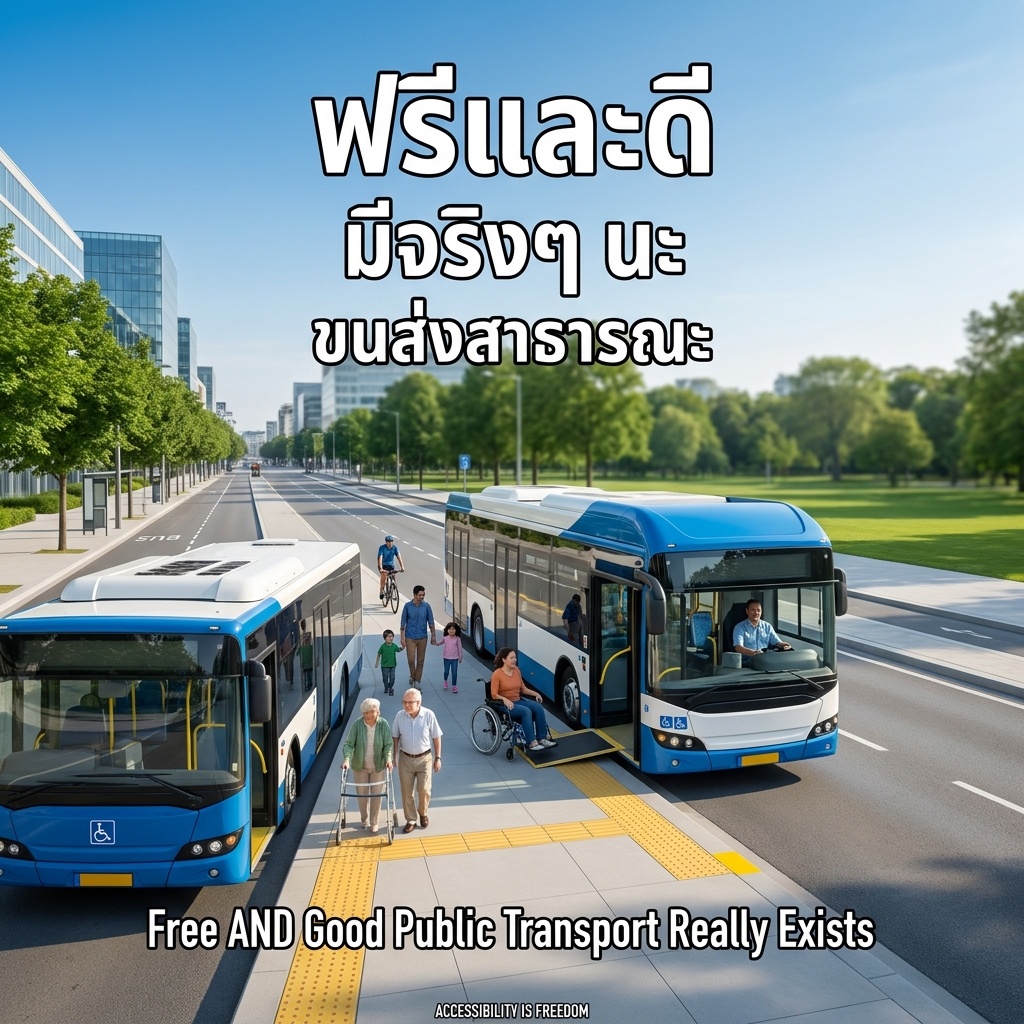
Ever wondered if a city where buses, trams, and trains are free for the whole country — and actually work for everyone — really exists? Let me tell you… it does. And it’s not just one city. Three countries in Europe have proven that “free and good” is truly possible.
🇱🇺 Luxembourg was the first country to make public transport free nationwide on March 1, 2020, covering buses, trams, and standard trains—designed so “everyone can use it.” Adapto offers door-to-door service for people with permanent mobility limitations, and Mobibus serves those with reduced mobility; a 2022 law requires all buildings and public spaces fully accessible by 2032. Adapto cardholders book by phone or app in advance, with kerb-to-kerb pick-up and drop-off.
🇲🇹 Malta, a small Mediterranean island, has offered free public transport since 2022 via the Tallinja card. In July 2026, parliament unanimously passed a law protecting disability rights in the constitution, committing €69 million (about 2,700 million baht) to disability services—including door-to-door transport for ALL wheelchair users, no exceptions, even for older adults. That budget also covers youth rehabilitation centers, community hubs, and accessible transport pilots.
🇪🇪 Tallinn, Estonia’s capital, became the first European capital to offer free public transport to residents in 2013 after a landslide citizen referendum. Most new buses and trams are low-floor, easing travel for wheelchair users and those with mobility impairments—fewer stairs, fewer barriers.
These three countries prove “free and good” is achievable. Designing transport everyone can use isn’t a fantasy—it’s a matter of decision and design. Truly commendable.
Sources: Research on 3 European countries