
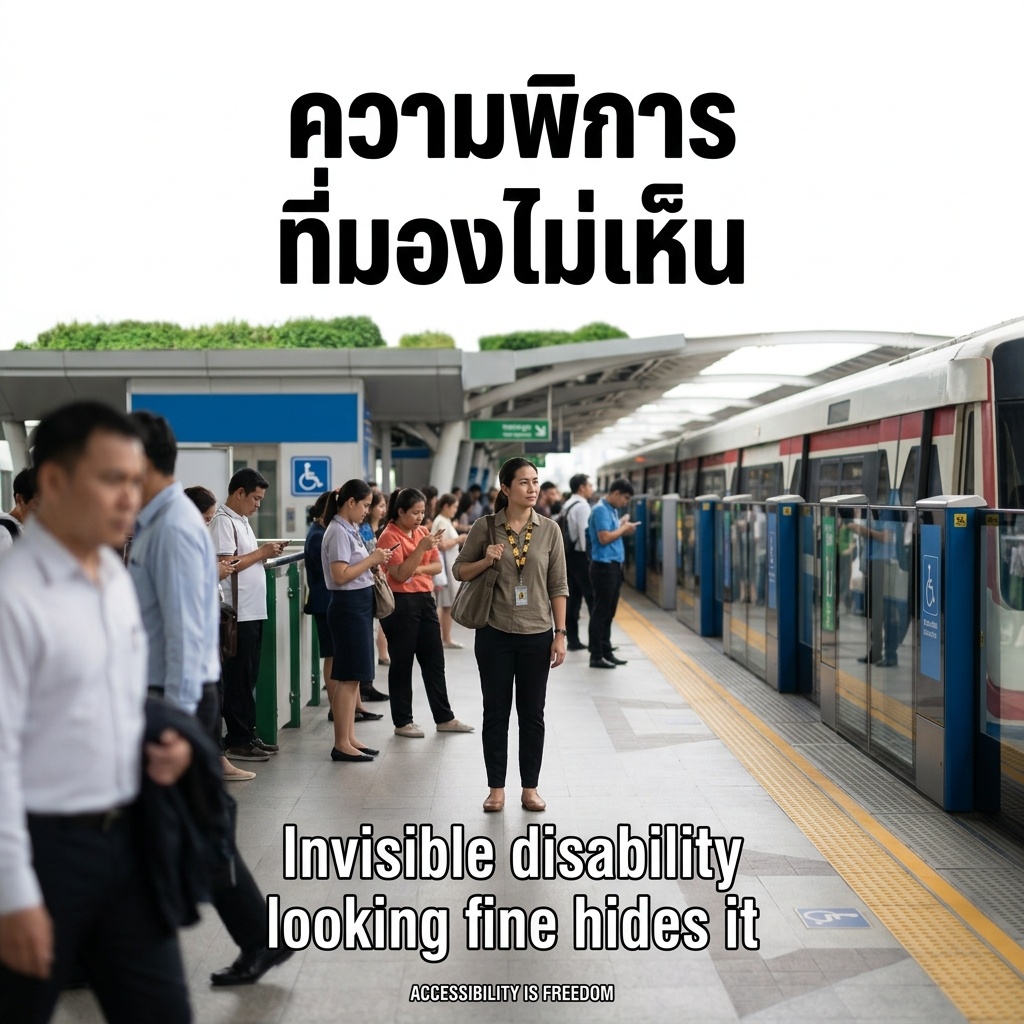
People around us look ordinary, yet live with an invisible disability.
An invisible disability means the body, mind or nervous system works differently from most people, with no visible sign. The World Health Organization estimates 1.3 billion people, 16% of the world, live with significant disability.
One clear example: people with hearing disabilities, or Deaf people, as they call themselves. Research in the journal JSLHR found many adults with hearing loss cannot follow speech through opaque face masks: lip-reading fails once the mouth is covered.
Or autistic people forcing themselves to blend in all day, until, as many say, they run out of energy.
In Thailand 🇹🇭 the numbers are clearer: 2,215,079 persons with disabilities are registered, but a UNICEF and National Statistical Office survey estimates 4,192,291, almost 2 million more. Many in that gap have an invisible disability, which does not match how we picture disability.
WHO notes people with disabilities are 2 times more likely to have depression and diabetes, so noticing an invisible disability early, and listening to people around us, matters.
Real solutions exist: in 2016 Gatwick Airport in the United Kingdom 🇬🇧 launched the Sunflower lanyard, so people needing extra help can ask without explaining. It is now law in Brazil 🇧🇷 and Uruguay 🇺🇾.
In the UK 🇬🇧, Morrisons runs an afternoon quiet hour at 439 branches.
Australia 🇦🇺 Coles also holds quiet hours with less music and bright light, so people sensitive to sound and light, including many autistic people, shop with ease.
Useful tools need not cost much: a map of loud or bright spots and quiet rest areas, communication cards for people who cannot speak when unwell, and staff trained to ask a short “can I help?” rather than guess.
This is close to home. Notice the people beside you more, and listen before judging: when we see one another more clearly, every journey gets easier for everyone. Have you met a situation like this? Tell me about it. 💙
Sources:
• World Health Organization (WHO) – Disability statistics and health inequalities – https://www.who.int/news-room/fact-sheets/detail/disability-and-health
• Invisible Disabilities Association – Definition of an invisible disability – https://invisibledisabilities.org/what-is-an-invisible-disability
• Journal of Speech, Language, and Hearing Research (ASHA) – Research on the effect of face masks on listening for people with hearing loss – https://pubs.asha.org/doi/abs/10.1044/2023_JSLHR-23-00163
• The 101 World – Registered disability figures and survey estimates in Thailand – https://www.the101.world/unrecognized-disability
• Hidden Disabilities Sunflower – History of the Sunflower lanyard – https://hdsunflower.com/us/insights/post/history
• Morrisons – Quiet hour in its stores – https://www.morrisons-corporate.com/media-centre/corporate-news/morrisons-introduces-new-afternoon-quiet-hour-to-help-shoppers
• BBC News – Morrisons opens quiet hours at 439 stores across the UK for autistic people (2018) – https://www.bbc.com/news/uk-44884183