
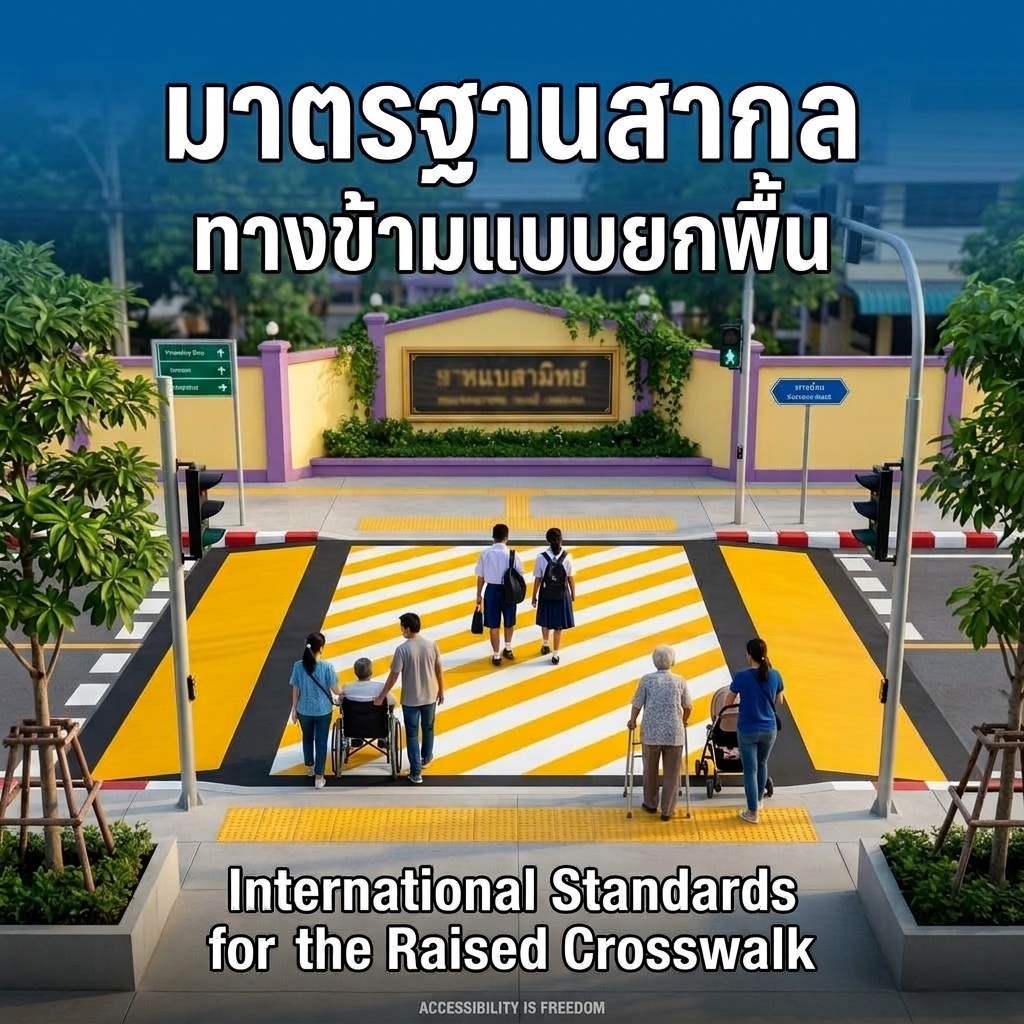
A raised crosswalk is a zebra crossing lifted flush with the sidewalk, with a speed table serving as the crossing itself. Cars still drive over it, but they must slow down. If they don’t, the driver feels the bump for sure.
Its heart is height, about 10 cm. If the person waiting to cross is a wheelchair user, a small-built person or a child, that height lifts their gaze from under the hood up near the windshield. Driver and pedestrian see each other at once, and once everyone sees each other, the car slows first.
Height standards for the hump
– FHWA: 75-150 mm, mostly 76-89 mm
– NZTA: 100 mm (10 cm)
– UK: 75-100 mm
– Fire trucks or ambulances on the route: ceiling 75 mm
Standards these countries have already set
United States🇺🇸: the FHWA states plainly that this is a wide, flat speed hump with the crossing painted over it.
United Kingdom🇬🇧: has LTN 1/07 on traffic calming.
New Zealand🇳🇿: has raised footways and raised zebra crossings, with kerb ramp requirements.
Australia🇦🇺: has the Austroads guide.
NACTO and GDCI write it into their urban street design guides too. Every one has the numbers and a responsible agency.
Flat top and ramps
– FHWA: 3.0 m top, 1.8 m ramps
– NZTA: 2-6 m, slope no steeper than 1:15 at 30 km/h
– UK: at least 6 m, 1:15
Slope and size
– NACTO: no steeper than 1:10, no flatter than 1:25, side slope max 1:6, edge mismatch max 6 mm, plus a W17-1 driver warning sign
– FHWA: 3.0 m wide, so front and rear wheels are on the raised surface together
Once a raised crosswalk is flush with the sidewalk, the edge that used to warn people is gone.
– FHWA: textured surface, or tactile marking plus contrasting colour
– NACTO: detectable strips, always
– NZTA: warning surface across the full width of the kerb ramp
NZTA points out that this design removes the kerb ramp, so the footpath continues across the street.
In 2001, the FHWA compared vehicle speeds at raised crossing points with points that were not raised.
Speeds at the raised crosswalk ran 6.5 to 19.3 km/h lower than at the non-raised points, and drivers yielding to pedestrians rose clearly when they saw the flashing warning lights above the sign. That matches the idea that a raised crossing is physical enforcement: if the car doesn’t slow, the driver feels it. The result came from two raised crossing points in Durham, North Carolina, and held up at both. The unreliable one came from another point, in Maryland, with only a few dozen vehicles measured, and it is still unclear how much the flashing lights helped.
Thailand🇹🇭: from what I can search, there is still no national standard. The good news is that the Bangkok Metropolitan Council has proposed that the BMA build raised crossings and give pedestrians the green light before cars.
What’s encouraging is that we already see some built in front of schools.
The BMA’s Traffic and Transportation Department (สจส.) piloted raised crossings in front of four schools: Assumption Primary, Sathorn Soi 11, Wat Chong Nonsi, Wat Amphawa, Charan Sanitwong Soi 22, and Wichakorn, Mitmaitri Soi 2. The crossings sit flush with the sidewalk, and their stated reason is that it mainly helps wheelchair users. Crossing warning signs and steep-slope warning signs go up 50 m before the crossing, and there are plans to expand to more schools, offices, shopping centres and community areas.
We’re only one small step short: national raised crosswalk design standards, announced so that every agency uses the same ones.
When there is a raised crossing, everyone is safer.
Sources:
• Federal Highway Administration (FHWA) — Raised Crosswalk countermeasure technical sheet — https://safety.fhwa.dot.gov/ped_bike/step/docs/techSheet_RaisedCW2018.pdf
• Federal Highway Administration (FHWA) — Traffic Calming ePrimer, Module 3 Part 2 — https://highways.dot.gov/safety/speed-management/traffic-calming-eprimer/module-3-part-2
• Federal Highway Administration (FHWA) — study of the effect of raised crosswalks on vehicle speed (2001) — https://www.fhwa.dot.gov/publications/research/safety/pedbike/0104.pdf
• National Association of City Transportation Officials (NACTO) — Urban Street Design Guide: Speed Table — https://nacto.org/publication/urban-street-design-guide/street-design-elements/vertical-speed-control-elements/speed-table
• Global Designing Cities Initiative (GDCI) — Global Street Design Guide: Crossing Types — https://gdci.wpengine.com/publication/global-street-design-guide/designing-streets-people/designing-for-pedestrians/pedestrian-crossings/crossing-types
• Waka Kotahi NZ Transport Agency (NZTA) — Pedestrian network guidance: Pedestrian platforms — https://www.nzta.govt.nz/walking-cycling-and-public-transport/walking/walking-standards-and-guidelines/pedestrian-network-guidance/design/crossings/non-priority-crossing-aids/pedestrian-platforms
• Waka Kotahi NZ Transport Agency (NZTA) — Pedestrian network guidance: Raised zebra crossings — https://www.nzta.govt.nz/walking-cycling-and-public-transport/walking/walking-standards-and-guidelines/pedestrian-network-guidance/design/crossings/priority-crossings/raised-zebra-crossings
• Waka Kotahi NZ Transport Agency (NZTA) — Pedestrian network guidance: Kerb ramp design — https://www.nzta.govt.nz/walking-cycling-and-public-transport/walking/walking-standards-and-guidelines/pedestrian-network-guidance/design/crossings/crossing-design-principles/kerb-ramp-design
• Department for Transport, United Kingdom — Local Transport Note 1/07: Traffic Calming — https://assets.publishing.service.gov.uk/government/uploads/system/uploads/attachment_data/file/918429/ltn-1-07_Traffic-calming-guidance.pdf
• Austroads — Guide to Road Design Part 4: Intersections and Crossings — https://austroads.gov.au/publications/road-design/agrd04
• Matichon Online — Bangkok Metropolitan Council proposes the BMA build raised crossings and give pedestrians the green light before cars — https://www.matichon.co.th/local/news_5829485
• Thai PBS The Active — Bangkok’s road safety plan — https://theactive.thaipbs.or.th/news/safety-20250121
• Thairath — New raised zebra crossings, BMA pilots at 4 schools, drivers must slow down — https://www.thairath.co.th/newspaper/2809124