

Rain has stopped, but Thailand water levels aren’t settled. The Meteorological Department closed its heavy-rain warnings at issue 18, the last. How much can actually drain out?
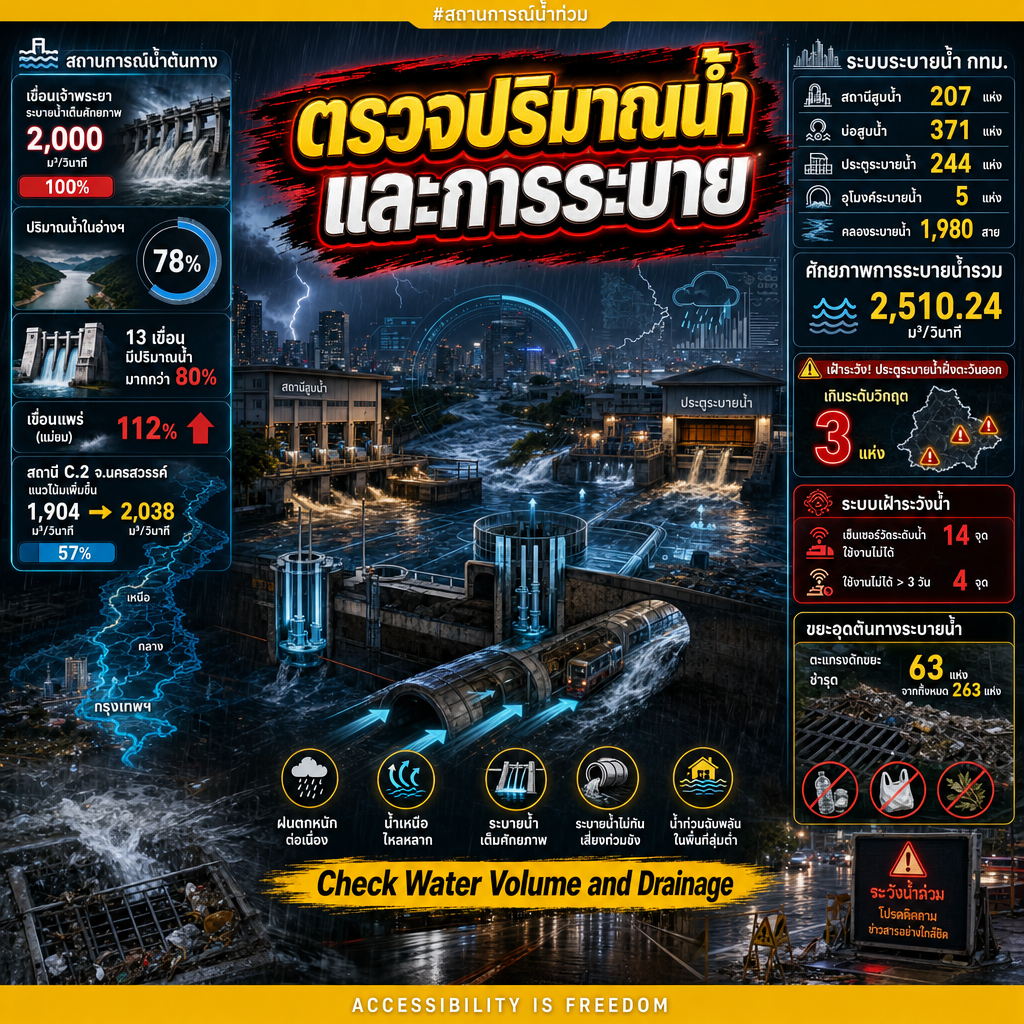
Chao Phraya dam discharge on 29 September 2026: 2,000 m³/s, 100% of the not-more-than-2,000 ceiling set to ease Bangkok. On 28 September, 2,091 – above that ceiling.
The Royal Irrigation Department reports Thailand dam levels at 78% across large and medium dams nationwide, 16,591 million cubic metres spare, 13 above 80%, Prasae Dam highest at 112%. EGAT reports its reservoirs 80%, the National Water Resources Office 77%.
On the Chao Phraya, Thailand water levels still rise: Nakhon Sawan (C.2) 1,904 to 2,038 m³/s, 2.86 metres below the bank – about 57% of the Qmax 3,590 m³/s the Drainage Bureau cites. The Ping River at P.7A 563 to 3,000 m³/s. Northern water hasn’t peaked.
Northeast: the Mun at Ubon Ratchathani (M.7), 0.74 metres below the bank.
Now Bangkok. The Bangkok drainage system is:
1️⃣ 207 pumping stations
2️⃣ 371 pump wells
3️⃣ 244 drainage gates
4️⃣ 5 tunnels
5️⃣ 1,980 canals
Water-management expert and former adviser to the Bangkok Governor, Atthaset Phetmeesri, told ThaiPublica on 27 September 2026 that the downstream pumping stations pushing water into the Chao Phraya run at about 30% efficiency, adding: “Worse, some stations are under repair, so the pumps can’t be used.” That is why water leaves slowly. The 30% is his own estimate, basis unstated, not a Bangkok Metropolitan Administration figure. The Drainage Bureau disputed such assessments in 2022: “Assessing pumping efficiency requires flow meters on the pumped water… not self-assessment.”
On 29 September 2026, three eastern gates passed critical levels:
1️⃣ Khlong Song drainage gate (south line) +1.92 vs +1.80
2️⃣ Saen Saep (Min Buri) +1.09 vs +0.70
3️⃣ Lat Krabang +0.82 vs +0.35
Bangkok rushes drainage at 81 main-road points, sending 1,200 m³/s via Prawet Burirom Canal to the Phra Khanong gate. The Drainage Bureau states total capacity 2,510.24 m³/s (28 October 2022).
From headwaters to Bangkok, six points in Thailand water levels compare as percentages.
Every percentage compares that point’s figure with the value the same owner publishes for that point, same day – never across points.
Volume compares with that point’s Qmax; water level with its flood barrier.
1️⃣ Nakhon Sawan (C.2) 2,038 vs Qmax 3,590 m³/s = 57% (data 29 September 2026)
2️⃣ Chao Phraya Dam 2,000 vs Qmax 2,840 m³/s = 70% (data 29 September 2026)
This 70% uses a different base from the 100% above: 100% compares with the not-more-than-2,000 drainage ceiling, 70% with Qmax.
3️⃣ Rama VI Dam 617 vs Qmax 700 m³/s = 88% (data 28 September 2026; the 29 September report left this cell blank)
4️⃣ Sam Khok (average) 1,814 vs Qmax 3,500 m³/s = 52% (data 29 September 2026)
5️⃣ Pak Khlong Talat highest water +2.05 metres vs barrier +3.00 metres = 68%
6️⃣ Bang Na highest water +1.80 metres vs barrier +2.80 metres = 64%
The last two use 28 September 2026 values: the 29 September report gave none.
All six are one waterway from headwaters to Bangkok – the volumes its drainage system must take, against the capacity above.
The Drainage Bureau reports 14 water-level gauges feeding Thailand water levels aren’t reporting.
Four have been down more than three days.
Flow-rate stations are out at 4 of 50 sites, including the Lat Krabang gate and Khlong Lat Phrao, on daily-report figures.
A downed gauge isn’t a broken canal or gate: the source didn’t call them damaged and no agency publishes readiness per station.
The Khlong Saen Saep gauge in Bang Kapi, missing on 28 September, returned on 29 September at +0.86 metres against a critical +0.45 – transmission failure, not a damaged gate.
The sharpest point isn’t the pumps but automatic trash collectors: 63 of 263 out of service (2022).
Bangkok blames an insufficient budget, so trash is cleared by hand – and news on 28 September 2026 confirms it still clogs pump screens.
The flood barrier hasn’t broken: its 51 gaps and port openings, 2.7 kilometres, are sandbagged.
Full high tide: 1 October +1.14, 2 October +1.16 metres. The sea holds water back, slowing outflow.
1-2 October isn’t the peak – the real peak is 27-29 October.
The National Water Resources Office warns of high sea tides 29 September to 4 October: 8 provinces, 4 river basins, 3 roads.
Good news: the tide hasn’t pushed salinity up the river – latest readings below 0.25 grams per litre.
1️⃣ 0.09 grams per litre
2️⃣ 0.16 grams per litre at two points
The Department of Disaster Prevention and Mitigation reported on 28 September that 27 provinces plus Bangkok were affected: 576,449 households, 1,793,887 people.
Deputy Governor Tavida Kamolvej says Bangkok’s first mission is reaching vulnerable groups – bedridden patients, older adults, people with disabilities, those with limited mobility – and hotlines 1669 and 1555 take evacuation requests.
Now follow Thailand water levels from their owners – the Royal Irrigation Department, the Meteorological Department and the Drainage Bureau – and prepare your household plan. When the water comes isn’t something we just wait for.
Or follow here, where we summarise every source clearly, with references.
Sources:
• Royal Irrigation Department — report on water conditions in the 2026 rainy season, and warning notice No. 2 on water conditions above Chao Phraya Dam — https://water.rid.go.th/flood/flood/daily.pdf
• Electricity Generating Authority of Thailand — reservoir and dam situation as of 29 September 2026, 00:00 — https://water.egat.co.th/situation/index.php
• National Water Resources Office — summary of Thailand’s overall water situation, 28 September 2026 — https://www.bangkokbiznews.com/news/news-update/1254028
• National Water Resources Office — high sea tide warning, 29 September – 4 October 2026 — https://www.bangkokbiznews.com/news/news-update/1254018
• Hydrographic Department, Royal Thai Navy — tide tables for Thai waters 2026 (high water-low water, m.s.l.) — https://hydro.navy.mi.th/
• Hydrographic Department, Royal Thai Navy — water level table index by station — https://hydro.navy.mi.th/waterlaveltable
• Meteorological Department — 7-day forecast — https://www5.tmd.go.th/forecast/sevenday
• Drainage Bureau, Bangkok Metropolitan Administration — daily water situation report — https://weather.bangkok.go.th
• Drainage Bureau, Bangkok Metropolitan Administration — daily water situation report No. 272/69, 29 September 2026 — https://dds.bangkok.go.th/public_content/files/001/0004901_1.pdf
• Drainage Bureau, Bangkok Metropolitan Administration — canal water-level monitoring system, by station — https://weather.bangkok.go.th/water/
• Drainage Bureau, Bangkok Metropolitan Administration — flow-rate monitoring system, by station — https://weather.bangkok.go.th/flow/
• Drainage Bureau, Bangkok Metropolitan Administration — annual action plan 2024 (drainage capacity data as of 28 October 2022) — https://infocenter.oic.go.th/FILEWEB/CABINFOCENTER9/DRAWER012/GENERAL/DATA0004/00004852.PDF
• Ms. Tavida Kamolvej, Deputy Governor of Bangkok — statement on the flooding situation and assistance to the public (28 September 2026) — https://www.naewna.com/n/national-news/85440/
• Department of Disaster Prevention and Mitigation — disaster situation report, 28 September 2026 — https://www.bangkokbiznews.com/news/news-update/1253932
• ThaiPublica — Bangkok flood crisis: no one monitoring, ‘water traffic – pumps at 30% efficiency’, water expected to recede in 2-3 days (27 September 2026) — https://thaipublica.org/2026/09/bangkok-flood-no-monitor-water-pump-30-percent-efficiency/
• INN News — Governor Chadchart confirms Bangkok is ready for heavy rain, managing ‘rainwater and northern water’ separately (23 September 2026) — https://innews.news/news.php?n=101369
• Daily News — ‘Chadchart’ orders inspection of 190 pumping stations after more than 15 years of use (29 July 2022) — https://www.dailynews.co.th/news/1303984/
• Daily News — Drainage Bureau rebuts pump assessment, says engineering principles required (28 July 2022) — https://www.dailynews.co.th/news/1300104/
• Spring News — The rain has stopped, so why won’t Bangkok’s 2026 floods recede? (28 September 2026) — https://www.springnews.co.th/news/hot-issue/865222