
Since I visited Japan and Tokyo, I’ve felt the attention to detail in their rail system. Trains are well-designed, clean, and punctual. These things reinforce my image of timeliness and responsibility — but there’s still plenty to improve.
It’s been a while, so let me dig into current data.
First, the scale: Tokyo’s main urban area has 14.27 million people, compared to Bangkok’s 8.3 million. There are over 1,200 train stations here (Bangkok: 135). Shinjuku Station, Tokyo’s largest, handles 3.8 million passengers daily — more than half of Bangkok’s entire weekly rail ridership. According to Tokyo Metro, every 30 minutes during peak hours, over 20 trains run on the Chuo Line, a historic route.
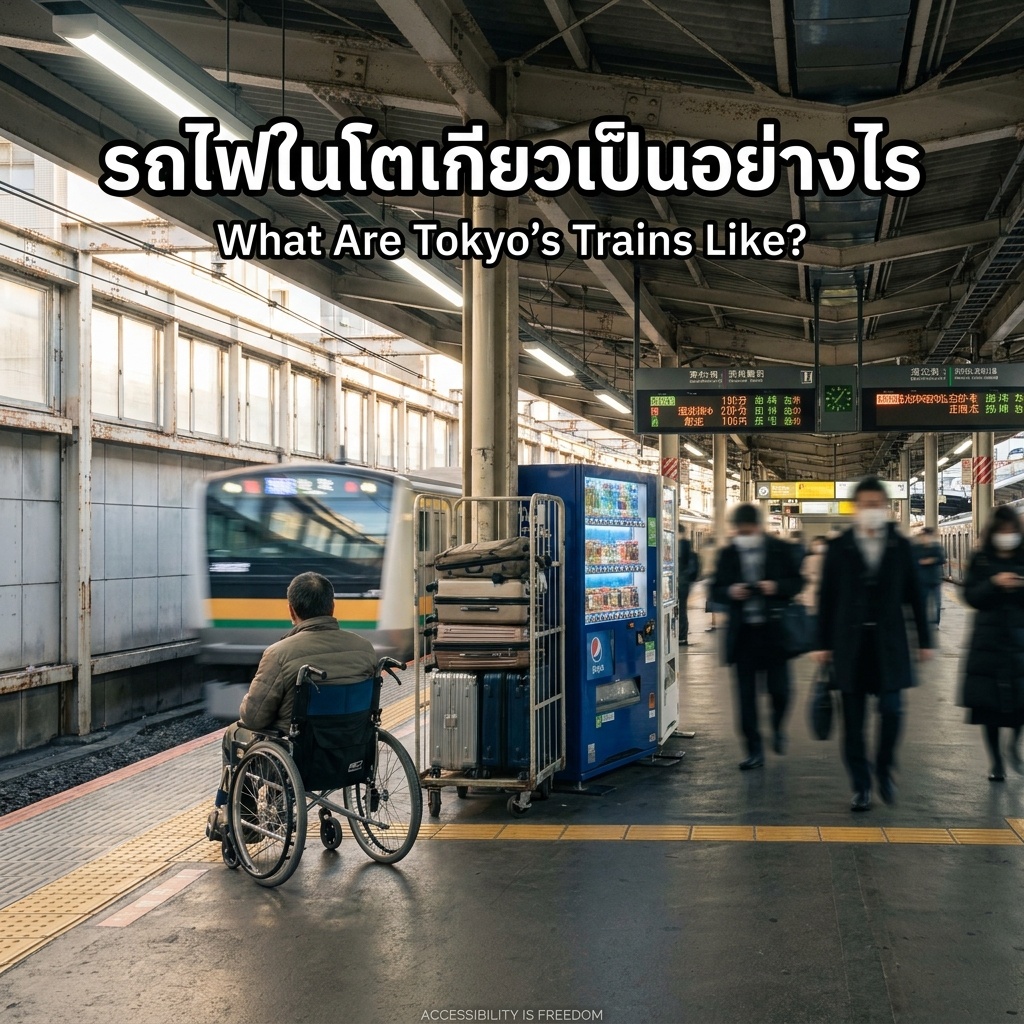
On accessibility — tactile paving, which we know as guidance tiles for people with visual impairments, was invented by a Japanese man, Miyake Seiichi (1967). It’s now a global standard. A key law, the Barrier-Free Act, was enforced in 2006, requiring public places including stations to be accessible.
Data from Nippon.com (2014) shows that 83% of major stations with 3,000+ daily passengers are accessible. But nationwide, out of over 9,500 stations, only 43% are accessible — revealing a two-tier standard between urban and rural areas.
On labor — in 2024, Japan had 677,461 people with disabilities working, or 2.41% of the total workforce. That’s close to the national quota of 2.5%, which will rise to 2.7% in July 2026. Many civil society groups are pushing for 3%.
Staff assistance is another key factor. While JR East trains its personnel to a standard, many real users report uneven service across stations — some excellent, some where staff don’t know the procedures.
BBC reports that rail accessibility in remote areas is a major challenge for Japan’s government, which is now consulting with disability groups on solutions.
JICA (2026) states that the real goal of accessibility is independent travel on the same schedule and routes as everyone else. What Japan needs to improve isn’t just the number of elevators or ramps — but a guarantee that every station meets the same standard.
Sources: Barrier-Free Act, Nippon.com, Japan Times, The HR Digest, BBC, JICA