

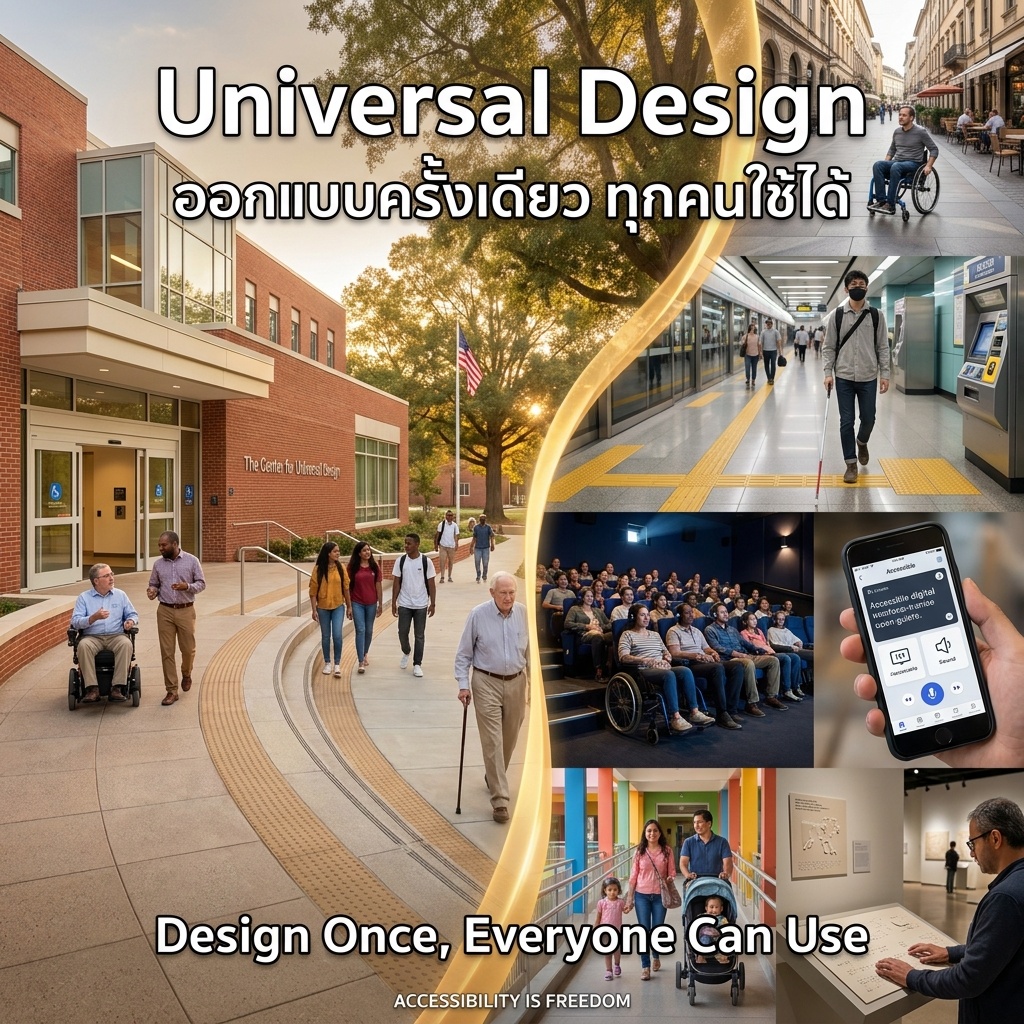
Friends, have you ever wondered why we have wheelchair ramps, elevator buttons with tactile markings, or captions on videos? That’s Universal Design at work — designing things so everyone can use them from the start, without needing a separate version for anyone.
In 1997, a design team led by Ronald Mace at North Carolina State University 🇺🇸 defined the 7 Principles of Universal Design, which remain the standard today:
1. Equitable Use — The design works for people of all backgrounds, equally.
2. Flexibility in Use — It accommodates a wide range of preferences and abilities.
3. Simple and Intuitive Use — It’s easy to understand, without complicated thought.
4. Perceptible Information — It communicates essential information effectively, regardless of the user’s sensory abilities.
5. Tolerance for Error — It minimizes hazards and the consequences of mistakes.
6. Low Physical Effort — It can be used efficiently, comfortably, and with minimal fatigue.
7. Size and Space for Approach and Use — It provides appropriate size and space for access and use, regardless of body size, posture, or mobility.
These principles guide the evaluation and design of everything from buildings and websites to information systems.
A real-world example is CINEMA Chupki TABATA, Japan’s first universal cinema 🇯🇵, founded by Chihoko Hiratsuka in 2001. She designed every screening with built-in audio description — no separate “special screenings for people who are visually impaired.” Everyone watches the same screening, and it works for everyone from the start.
This is the heart of Universal Design: good design isn’t about doing something extra for someone — it’s about considering everyone. It’s about accepting that every human being is different, which is a fundamental truth (one we often forget).
Share this to spread knowledge, empower each other, and build an equal society.
Sources: NCSU, CINEMA Chupki TABATA, Vispero