

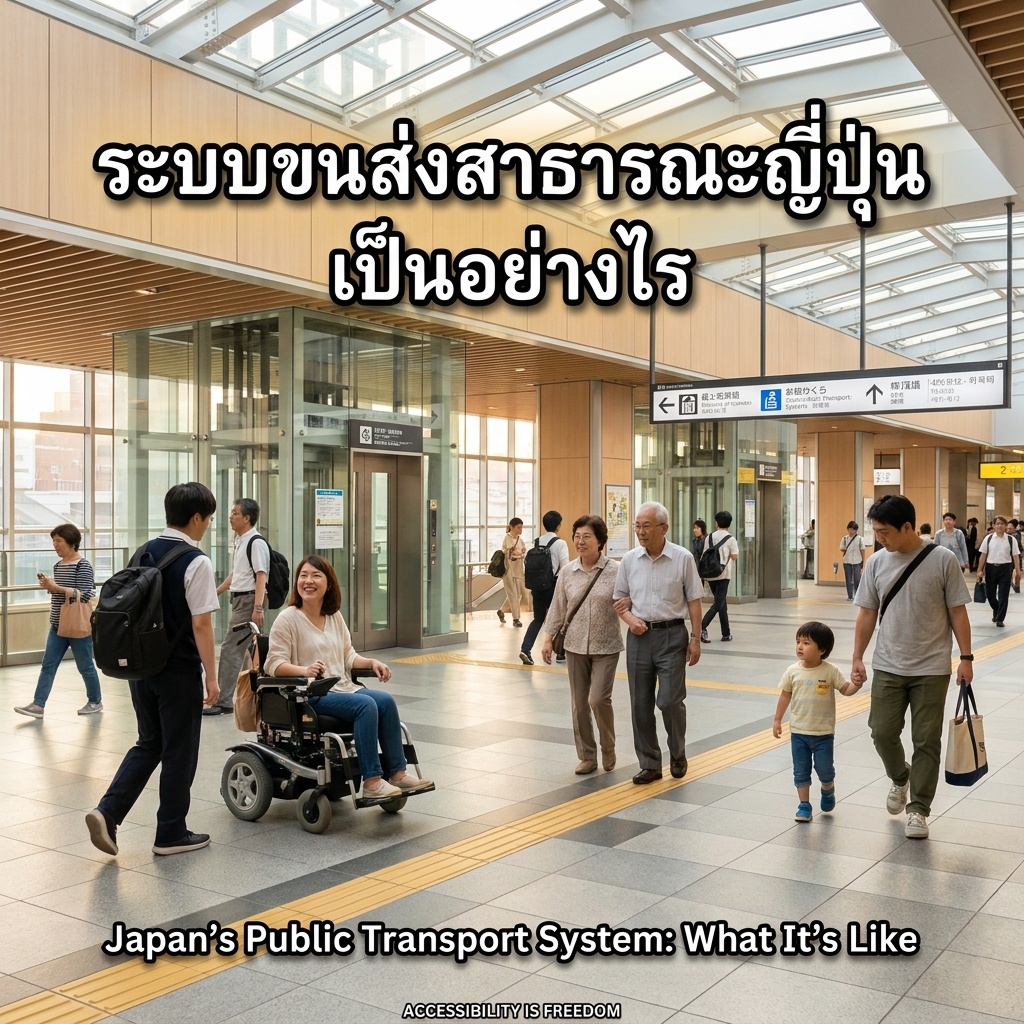
When it comes to accessible public transport, Japan leads. Since 2008, its Barrier-Free policy requires all new infrastructure — train stations, airports, roads — to be fully accessible for wheelchair users and people with all disabilities.
Compare Thailand: Japan has 378,000 km² and 125 million people. Thailand: 513,000 km² and 66 million. Japan is denser yet far more accessible.
Japan has over 9,500 train stations. 45 of the world’s 50 busiest stations are in Japan. Shinjuku handles 3.8 million passengers per day. The Shinkansen carries 385.9 million per year. With wheelchair-accessible trains, over 209,000 non-step buses, and more than 50,000 Universal Design taxis in Tokyo — all equipped with ramps and high roofs.
Tactile paving was invented by Seiichi Miyake in 1965 and became a global standard. Major airports offer step-free paths, priority lanes, and multilingual assistance.
The Barrier-Free Act requires stations, public buildings, and roads to provide wide elevators with low buttons, accessible toilets, and ramps. Gaps remain in rural areas, but Japan is a model Thailand should study.
I believe if we commit to vision and law, Thailand’s transport can reach that level. What Japan did, we can do too.
Sources: Japan-Guide, Accessible Japan, JICA